Archaeologists Opened A Cave Chamber Sealed For 40,000 Years, Revealing The Lives Of The World’s Last Neanderthals
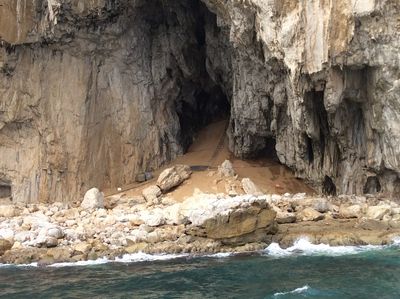
Gorham’s Cave complex on the Rock Of Gibraltar is a UNESCO World Heritage Site.
Image credit: Visit Gibraltar/Flickr (CC BY 2.0)
On the shores of the Mediterranean, a cave tells a fascinating story of life, death, and survival. When archaeologists excavated the site, they uncovered a living museum of Neanderthal life, complete with physical artifacts that document their rich culture and day-to-day habits. Perhaps most intriguing of all, the cave system even contained a hidden chamber that had been sealed for up to 40,000 years.
The Gorham’s Cave complex is located on the coast of Gibraltar, a British overseas territory perched on the southern tip of Spain. Nestled against steep limestone cliffs, this seaside warren is composed of four separate caves: Gorham’s Cave, Vanguard Cave, Hyaena Cave, and Bennett’s Cave.
It was once situated farther inland, but rising sea levels over thousands of years have brought the complex’s entrance to the very edge of the Mediterranean Sea.
The caves were first discovered in 1907, but they didn’t become the focus of formal archaeological excavations until the 1980s, when it became clear just how rich the site truly was.
Although no skeletal remains of Neanderthals or Homo sapiens have ever been found inside, there is abundant evidence of human activity spanning 100,000 years. This predates the arrival of modern humans in Western Europe around 40,000 years ago, indicating that this is the work of Neanderthals.

Some of the most crucial evidence comes in the form of seafood. Over the years, researchers digging at the cave have uncovered a huge quantity of mussel shells, as well as the bones of fish, seals, and dolphins. These remains couldn’t have reached the cave naturally by tide or waves, plus it’s evident that some of them have been processed using knives and other butchering techniques.
The floors are adorned with several cross-hatching patterns that have been deeply scratched into the bedrock. While there has been some dispute over the authorship of these markings, researchers have claimed they were created by Neanderthals over 39,000 years ago. Could these rough-and-ready etchings be considered artworks? If so, this would be yet another example of Neanderthals’ creative, intelligent side.
Speaking of their intelligence, more recent research in the Vanguard Cave has found a 60,000-year-old hearth that was used to cook up birch tar, a gloopy, glue-like substance used by prehistoric humans to attach handles to tools or weapons. This demonstrates that the residents of this cave were smart, resourceful, and perhaps handed down knowledge from generation to generation.
In 2021, researchers made another fascinating find at the complex. Archaeologists from the Gibraltar National Museum discovered a 13-meter (42-foot) deep chamber at the back of Vanguard Cave that had been sealed by sediment for at least 40,000 years. Their initial analysis found the remains of lynx, hyena, and a vulture. It seems unlikely that these animals stumbled into the chamber of their own accord; the team also found the shell of a large whelk, an edible type of sea snail, which must have been transported up to the chamber due to its distance from the water.
Neanderthals likely occupied Gorham’s Cave until between 33,000 and 24,000 years ago, which is incredibly recent. It is typically held that these hominins went extinct around 40,000 years ago, but the artifacts in Gibraltar suggest some populations might have held on much longer.
If all of these assumptions are accurate, it would indicate that some of the world’s very last Neanderthals lived in and around Gorham’s Cave – an idyllic setting in which to face the ultimate extinction of their kind.